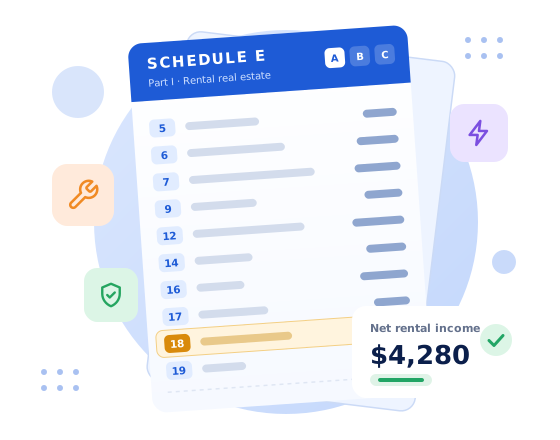
If you collect rent on a house, a duplex, or a few units, you report that income and your expenses on IRS Schedule E, Supplemental Income and Loss, Part I. The form gives each expense a numbered line, and the numbers on those lines are what you subtract from your rents received to arrive at your taxable rental income or loss. Knowing the lines ahead of time changes how you should keep records, because the easiest way to prepare Schedule E is to categorize each expense the way the form does from the start.
Here is the list. The sections after the table cover the lines that cause the most confusion.
| Line | Category | What typically goes here |
|---|---|---|
| 3 | Rents received | All rent you collected in the year, plus advance rent and any security deposit you kept |
| 5 | Advertising | Listing fees, signs, online ads for vacancies |
| 6 | Auto and travel | Mileage or actual vehicle costs for rental business trips, and qualifying travel |
| 7 | Cleaning and maintenance | Cleaning between tenants, lawn care, snow removal, pest control, routine upkeep |
| 8 | Commissions | Leasing agent fees for finding tenants |
| 9 | Insurance | Landlord, liability, flood, and other premiums on the rental |
| 10 | Legal and other professional fees | CPA, attorney, tenant screening, eviction costs |
| 11 | Management fees | Fees paid to a property manager |
| 12 | Mortgage interest paid to banks | Interest on your loan, as shown on Form 1098 |
| 13 | Other interest | Interest on other loans used for the property, such as a private lender or a credit card used for the rental |
| 14 | Repairs | Fixing things that are broken or worn, without improving the property |
| 15 | Supplies | Light bulbs, locks, smoke detectors, small tools, other consumables |
| 16 | Taxes | Real estate property taxes |
| 17 | Utilities | Water, sewer, gas, electric, trash, internet you pay for the property |
| 18 | Depreciation expense or depletion | Annual depreciation of the building and improvements, computed on Form 4562 |
| 19 | Other | Anything ordinary and necessary that does not fit above, with a description |
Line numbers are correct for the current form layout, but the IRS adjusts forms from time to time, so confirm against the form for the tax year you are filing.
The lines that confuse people most
Line 7 versus line 14, cleaning and maintenance versus repairs. Landlords often wonder which line a given cost belongs on, and the honest answer is that the tax result is the same, since both are fully deductible in the year paid. The distinction matters for tidiness and for how a reviewer reads your return. Routine and recurring upkeep, the kind of thing you do every month or every season, fits line 7. A discrete fix of something that broke or wore out, such as a plumber's visit or a replaced door lock, fits line 14. Pick a convention, apply it consistently across properties and years, and move on.
Line 12 versus line 13, mortgage interest versus other interest. Line 12 is only for interest paid to banks and other financial institutions, normally reported to you on Form 1098. Interest you pay to anyone else, such as the seller who carried a loan for you or a private lender, goes on line 13, and you should be ready to explain who the lender is. Interest on a credit card is deductible only to the extent the charges were for the rental.
Line 18, depreciation. This is the one line that does not correspond to a receipt in your folder. The amount comes from Form 4562, which applies the depreciation schedule for your property: residential rental buildings are generally depreciated over 27.5 years, land is not depreciable, and improvements and some equipment follow their own schedules. You carry the first year's calculation forward and keep the schedule for as long as you own the property. A very common mistake is to forget this line entirely because there is no bill attached to it, which gives up a deduction the IRS considers you entitled to regardless.
Line 19, other. Use it for legitimate costs that have no home elsewhere, for instance software subscriptions used to manage the rental, bank fees on a dedicated rental account, or HOA dues, which many landlords expect to see on a separate line but which end up here. The form asks you to describe each item. This is also the line that attracts scrutiny when it is large and vague, so keep the description specific and keep the supporting records.
Line 6, auto and travel. The most frequent reason this line fails an audit is the missing log. Whether you use the standard mileage rate or actual expenses, you need a contemporaneous record of the date, destination, miles, and business purpose of each trip. A reconstructed log created months later is much weaker than a running one.
Repairs and improvements: the capitalization question
Schedule E has no line for improvements, because an improvement is not an expense you deduct in the year paid. It is added to the property's cost basis and recovered through depreciation, which flows through line 18. If you put a new roof on a rental, the cost does not appear on line 14. It appears on your depreciation schedule. Getting this wrong in either direction is costly: treating an improvement as a repair risks a disallowed deduction, and treating repairs as improvements delays deductions you were entitled to take now. The small taxpayer safe harbor for buildings and the $2,500 per-item de minimis safe harbor can let you deduct some borderline items directly, but both are elections that must be made on your return, so raise them with your preparer.
Where the money goes on the form
Multiple properties
Schedule E has columns for up to three properties on one page, labeled A, B, and C. If you own more, you attach additional copies. Each property gets its own income and expense totals, so you need to know which property every expense belongs to. This is why landlords who track by category alone often struggle at tax time. A year's worth of "repairs" lumped together tells you nothing about which of your units generated them. Tag the property when you record the expense, not at the end of the year.
| Expense line | AMaplewood | BOakwood | CPine Hill |
|---|---|---|---|
| 14Repairs | $1,840 | $420 | $2,115 |
| 16Taxes | $3,200 | $2,850 | $4,100 |
| 17Utilities | $960 | $1,310 | $0 |
If you own a property jointly or through an entity, the reporting can change, so the above applies most directly to properties you own individually or jointly with a spouse. An LLC taxed as a partnership files differently, and a single-member LLC is generally reported on your Schedule E just as if you owned the property personally.
A few things that change which form you use
Schedule E is for ordinary rental activity. If you provide substantial services to tenants, as a hotel does, the income may belong on Schedule C instead. Short-term rentals add a further wrinkle: when the average stay is seven days or less, the activity is often not treated as a rental for passive loss purposes, and the reporting can differ. If you rent a property you also use personally, such as a vacation home, the number of rental days versus personal days determines how much of your expenses you can deduct. In each of those cases, a tax professional is worth consulting before you file.
Rental losses also run into the passive activity rules. Many small landlords can deduct up to $25,000 of rental loss against other income if they actively participate, but that allowance phases out for taxpayers with adjusted gross income between $100,000 and $150,000 and disappears above that. Losses you cannot use are not lost, since they carry forward, and they are tracked on Form 8582.
The $25,000 rental loss allowance, by income
Set up your records so the lines fill themselves in
The most useful thing you can do with this list is to build your record-keeping around it. Give every expense three attributes at the time you record it: the property it belongs to, the Schedule E category it falls under, and the date you paid it. If you do that consistently, filling in the form becomes a matter of adding up each category for each property, and your CPA gets a clean summary rather than a pile of receipts.
- The property it belongs toMaplewood Apartments
- The Schedule E categoryLine 14 · Repairs
- The date you paid itMarch 12
The same discipline protects you in an audit, because each total on the form can be traced back to individual documents. Keep the receipt or invoice for each expense, a brief note on what it was for, and your mileage log, for the period the IRS can examine your return, which is generally three years from filing but longer in some situations. Keep records for property purchases and improvements for as long as you own the property and for several years afterward.
Done once a month rather than once a year, this takes minutes. Done in a single sitting in March, it takes days and produces worse numbers.
This article is general information, not tax or legal advice. Tax forms and rules change from year to year and depend on your circumstances, so confirm the details with the current IRS instructions for Schedule E or a qualified tax professional.

Read next
What Can I Deduct as a Landlord?
The expenses small landlords can deduct, how repairs differ from improvements, and what to do before December 31.
Read the guide